
cilium's truth- analysis

Updated: Jul 17, 2022

overall, the data consist of mostly females from mauritius and malaysia between 20 to 25 years old.

when the participants were asked whether or not they shaved, all genders mostly responded with yes. they were then separated into age groups. it is seen that all genders of age 16 – 19 and 36 and above have the highest level in shaving of their bodies. the charts then sloped down to the age group 26 – 35.


it was observed that the shaving patterns are same across genders. here the graphs show the reasons they shave and are the opposite of one another. this can lead to conclusions that men do not have as many insecurities about their body hair unlike the females. this could be a leading factor which suggest why women are always victim of normative pressure.


now the analysis will move to the specific targeted gender and the females were sorted into age groups and the difference in opinions can be more noticeable. the pattern of disliking their own body hair can be noted since they were teenagers. what can be taken from this data is that ever since teenage hood, girls viewed body hair as disgusting and something dislike. arriving at the stage of adulthood, the normative pressure to shave their body hair increased which increase their reasons to shave and take it as ‘a normal practice.’ then it can be seen that reasons for shaving gets associated with ‘hygiene.’

the chart, the percentage of females who shave their body hair sorted into age groups. the graph inclined with each age group and can only see a decline from age 20 to 35 and then the curve climbs up again. what can be noted here is that based on their age, the females have different reason for shaving. it can be noted that even though they did not like their body hair, half of the females would still continue to keep their body hair, but once they start to feel the normative pressure, the number would drastically fall. most of them will start to shave and then arriving at adulthood, there will be a change in the curve again. between age groups 20 to 25, most are still shaving their body hair, however the curved declined from 100% to 95%. the response to 100% hair removal in age group 19 may be linked to the fact that they all felt that it was hygienic to do so and to maintain a proper hygiene, everyone indulged in body shaving. however, in age group 20 to 25, the main reason for shaving changed to feeling obligated and not liking body hair, 5% started to keep their body hair again. at age group 26 to 35, where they are fully adults the curved dropped down to be fifty-fifty again. this change can be linked to their maturity levels even though hygiene was still the most common reason for shaving. hygiene is just a justification of unacknowledged pressure (tiggemann, m. and lewis, c. 2004;385). there is even research by dermatologists that proves that keeping pubic hair is actually more hygienic to the body. (rowen ts, gaither tw, awad ma, osterberg ec, shindel aw, breyer bn. 2016)

the charts show the body parts that are mostly shaven by females. the most chosen body parts are the armpits, pubic area, and legs. a point that can be taken from this is that the advertising designs from the 20th century created such a significant impact that till now, people are still brainwashed and remove body hair from their armpits, pubic area, and legs. the pubic hair and armpit hair are always the ones that are most

commonly chosen across age groups which can be linked to the fact that those hair are always considered to be disgusting as they are near the genital area and covered in sweat. at the age of 20 to 25, other areas started to appear and in 26 to 35 age group, all the places that contain body hair were chosen. this behavioural pattern can be seen as the 20 to 25 age being mostly discontent with their body hair and feeling insecure about it due to feeling obliged to shave. however, in the age group 26 – 35, normative pressure and dislike for body hair was reduced significantly whereas the hygiene bar increase by a lot and all the body parts were chosen. as a research by tiggemann pointed out, women of these ages do not really acknowledge their hair removal practices as normative pressure. choosing to remove all body hair on their body on the pretence of hygiene could relate to feeling guilty to conforming to normative pressure or being a stage of new adulthood where the most natural way to fit in is to follow the hairless norm.

the chart shows how embarrassed females are about their body hair. what can be noted from this is when compared to the graph female shaving is that embarrassment of body hair does play a factor in their decision to shave. this can be taken into consideration that the hairless norm makes those with body hair embarrassed about their body hair and thus making it more different for women to find full positivity within their body.

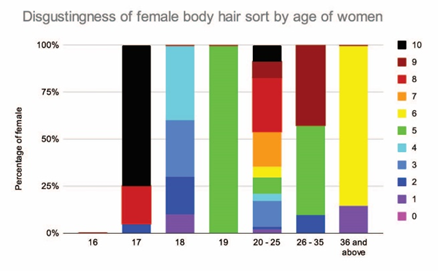
in the charts below, the data represents how females perceive female and male body hair, respectively. it can be noted that female body hair got more negative views rather than that of the male body hair. this can be associated with the disgust sensitivity and the cultural norm of perceiving something as dirt.

in the chart, it shows the if females would stop to shave if it was not a norm. it can be assessed that those who are in this period of adult transition are more susceptible to follow the norm to be accepted in society. they are young and have experience the normative pressure more than the teenagers, thus assuming most of them are making the safe choice of staying on the good side of society’s view. those ages from 26 to 35 may choose to be bold as they have grown out of the stage of new adults and are more confident about themselves and the society. however, females over 36 all choose to follow the trend and keep on shaving which can show that they are no more in a stage where they can be influence easily to come out of the norm.

the chart shows the females who would continue to shave even though they acknowledged that the hairless body is a normative pressure. with the responses given, the dept of the hairless norm can be seen. this shows that those whose who are trying to fit in society are the one that need to be aware the most.
this is the second part of the research which is the quantitative research with those that were willing to be interviewed. there were 25 participants for the interview and 10 of them do not remove their body hair and 15 of them remove their body hair. this interview is conducted to get a better understanding of their perspectives on body hair.
the first batch of interviewees were the one who were not removing their body hair and all of them were between 19 to 25 years old. the reasons why they choose so is because they find it bothersome to remove something that they consider natural, and others just have sensitive skin, so they do not remove it. however, it was noted that most of them hated the idea of gender inequity regarding matters of female body hair.
the second batch of interviewees were the majority who were removing their body hair. they all of different ages but among the age groups, the majority of them were the 17- to 18-year-olds and the 20- to 25-year-olds. they said they were embarrassed of their body hair and the reasons why is because they found it disgusting and unacceptable to be presented in public. some also mention its dark colour looked very ‘ugly’, ‘gross’ and ‘unladylike’ and some expressed that they were told to shave in order to look pretty and since then whenever they see their own body hair, they feel disgusted and body conscious. mostly all of them were very insecure about their body hair and preferred to stay hairless. they mostly feel like people will be disgusted to see their body hair and themselves feel very insecure about it. they mentioned being disgusted with body hair as it is smells in armpits and looks ‘ugly’ and ‘unladylike’. however, the reasons they stated for disliking male body hair was surprising. it was because the men sweat and do not shower, but mostly they seem furious that men do not have to deal with the normative pressure of the hairless body. many actually complained that the reason they hated male body hair is because the males could keep it without a problem but wanting women to be hairless.
what can be concluded is that women of different age groups have different response to their body hair and the body hair of other men and women. those who are more critical about body hair and who face the most pressure are the ages between 19 to 25. this can be assessed as they are in the stage of transition into adulthood, they are more pressured to be liked by others, and by their sexual partners. the reason of shaving for them revolves more on the normative pressure and not liking their body hair. they are also the age that started to shave more parts of their body.
the women who shave their body hair are very insecure about the natural state of their body. this is also proved in the research done by tiggemann and lewis, where normative pressure is the reason women cannot feel positive about their body image. being hairless seems like a normal thing in society, yet it is so dark when it is dig upon. countless of women participating in the body hair removal and feeling insecure on whether or not their hair has grown back and may be ridiculed in society. no one will actually walk up to someone and criticise them about their body hair, but this insecurity of being seen with body hair is depicted as going out ‘dirty’ like a savage. the damage that this norm causes should be talked about and create safe places where these women and girls can start to accept their body hair as something natural, something that proves that they are no longer children and be able to embrace their body and stop feeling insecure.
another survey will be done on this age group to understand their psychology and characteristic persona to find more how to create something that they can relate to and accept body hair as a natural part of their growth.
due to what was found in the analysis of the primary data, it is perceived that the disgust of body hair is very complex which makes the females insecure about their body image. this project will aim to reduce or at least make them accept that body hair is natural. to be able to make an outcome, one must understand what is disgust and how to accept and let go of the disgusting feeling. from the second century, disgust is defined as one of the ‘basic emotions’ (masson & patwardhan, 1970; hejmadi, 1998; shweder, 1993) and also through darwin’s (1872) expression of the emotions in man and animals. disgust emotion is unique in operating like a gatekeeper that manages what approaches the body closely. (miller, s. b. 2017). based on physiology, disgust is unlike other emotions which is associated with nausea. the behavioural pattern of disgust emotion is to distance oneself from the object of situation. distancing from such things may be accomplished by expulsion or removal of the cause of disgust. (rozin, haidt and mccauley, 1999).
based on studies, it was found that females are more affected by the disgust emotion thus making decisions under the risk factor. (sparks, a. m., fessler, d. m. t., chan, k. q., ashokkumar, a., & holbrook, c. 2018). research done by therapists shows that the first step to accept and letting go of the disgust feeling is to allow the feeling instead of force accepting it. (manotas, m. and psyd, 2015.) acceptance will come on its time. one should allow the feeling of disgust, be curious of the feeling and observe without making any judgments. like mentioned above, the disgust emotion acts as a gatekeeper that will automatically avoid the subject of disgust thus repressing oneself by making rash decision.
another primary research was conducted to understand the psychology of the 16- to 25-year-old females. the total amount of participants for this research is 64. what has been concluded from this research is that they value good self-care and actively show that is their priority by not shouldering any excess responsibilities such as having a pet or being in committed to relationships. based on their daily routines, which consist of mostly enjoying themselves and sleeping, it can be seen that they have a carefree characteristics, with their priority remaining their mental and physical needs. when comparing their study time and relaxation time, a big difference is noted, and this adds up to their carefree nature. it was also seen that they would prefer to be wear comfortable clothes both inside and outside their homes which suggest their strong relaxed personality. however contrary to their cheery persona, they would spend sleepless days to finish their assignments which shows that even though they spend little time studying, when deadlines are near, they will chang their pattern and do everything to be able to submit their works. that shows their hard determination to achieve what is best for themselves, whether it is as personal time or academic results. contrary to their free-spirited nature, they are also very passionate about social issues and if given the chance, they would want to pitch in. based on this, it is noted that an light-hearted approach to reach the audience would be most suitable, for example a fictional connotation of the concept.

fizz fizz...


Comments